
Leaving Gem River Edge was disorganised — or perhaps simply organised in Muna’s style.
There was never really a departure time. It kept being moved forward, but everything remained perfectly calm, somehow in the flow.
The Portuguese couple from the cooking class was also heading towards Ella, so we travelled together.
From Ella to the Tea Country
I had heard so many travellers rave about Ella. Yet when we arrived, it struck me as intensely touristy. It was difficult to tell where we were. It could have been almost anywhere in the world.
Up in the mountains, Ella was noticeably cooler than anywhere I had been in Sri Lanka so far.
The next day, we stopped at a hotel high above the valley. From its terrace, Ella looked very different. Low clouds hung over the mountains, moving across the slopes and sometimes hiding them completely. A waterfall appeared through the mist on the opposite side of the valley.
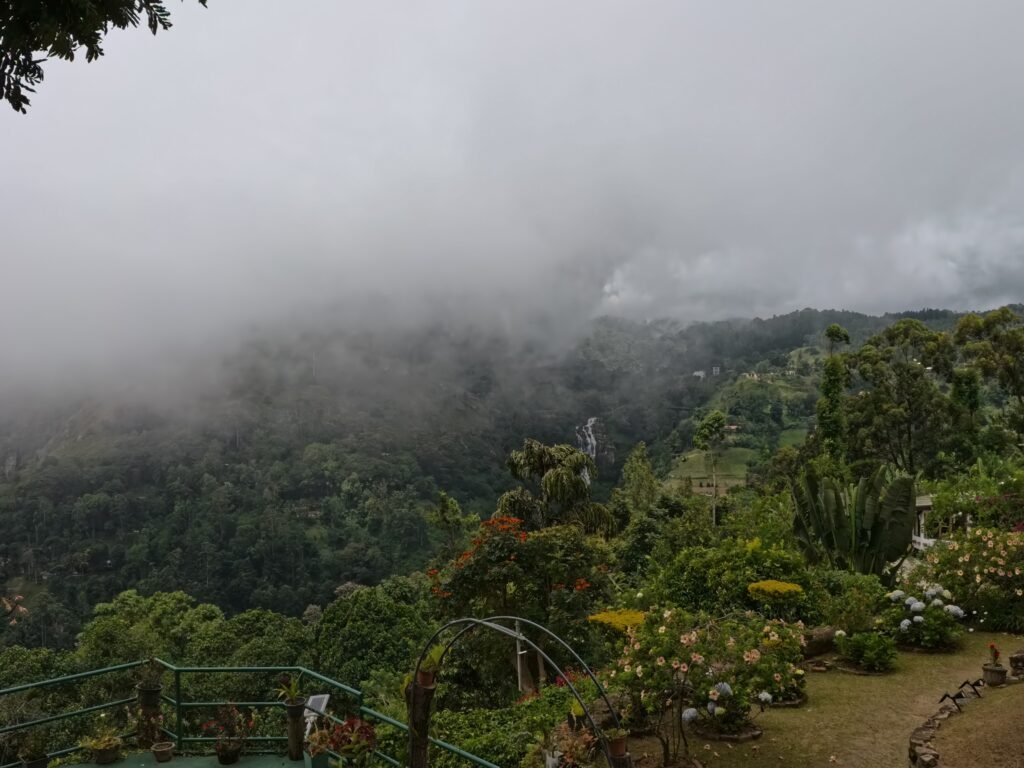
In the garden, among the flowers and trees, I spotted a lizard.
From Ella, we continued towards Haputale, deeper into Sri Lanka’s hill country. Tea began to take over the landscape, covering the slopes in dense, carefully shaped rows.
Muna rarely took the main roads. We followed narrow back roads, sometimes unpaved and not always easy, skirting ancient forests and climbing higher into the mountains. Water seemed to accompany us everywhere — running beside the road and, more often, falling from the sky.
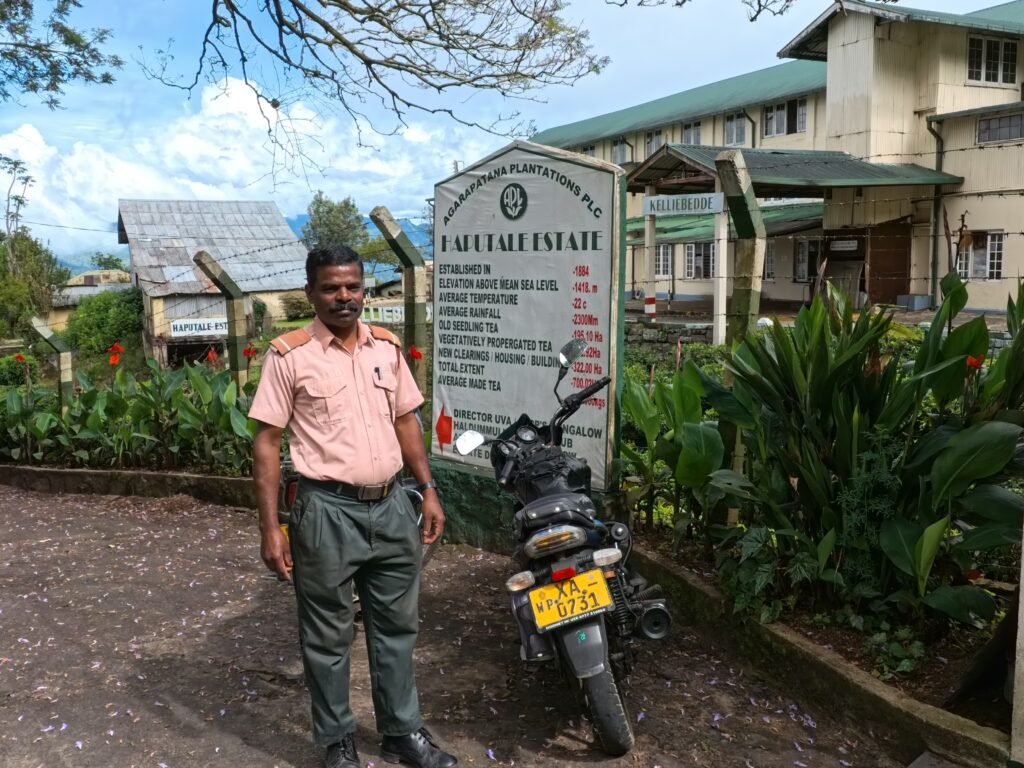
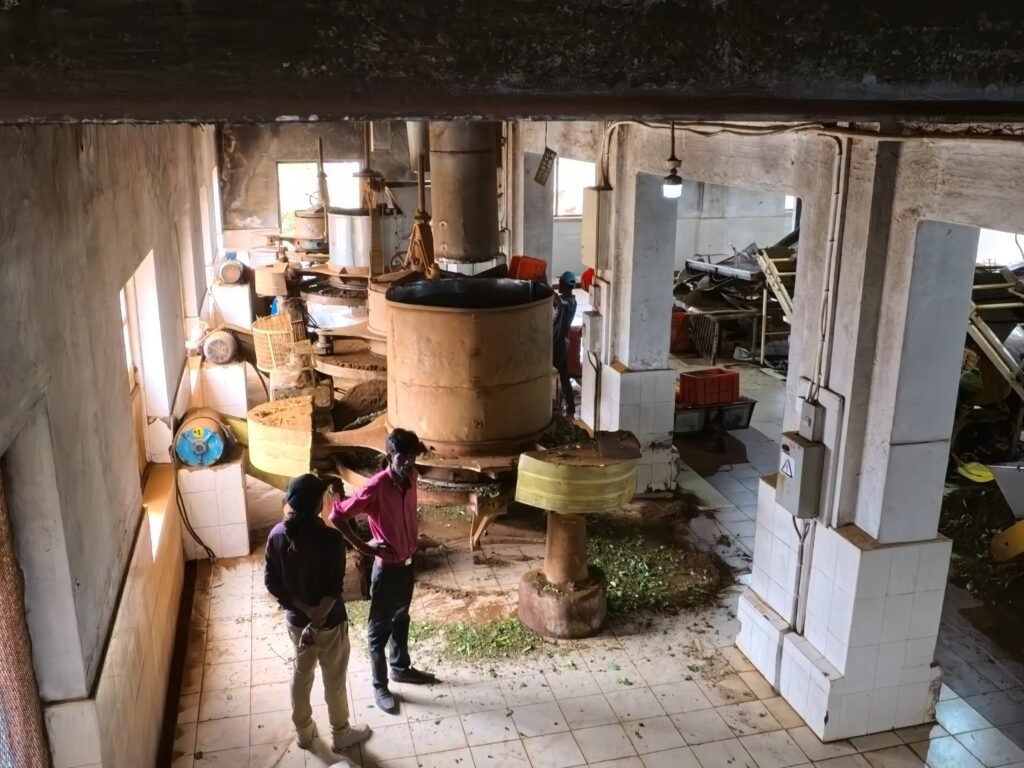
At Haputale Estate, we stopped at the Kelliebedde Processing Center. There were just two of us on the visit, accompanied by a member of the production staff. He took us through the factory, past machinery dating back to the British period, explaining the different stages of tea production.
Large sacks were filled with freshly produced black tea. Its aroma filled the air.
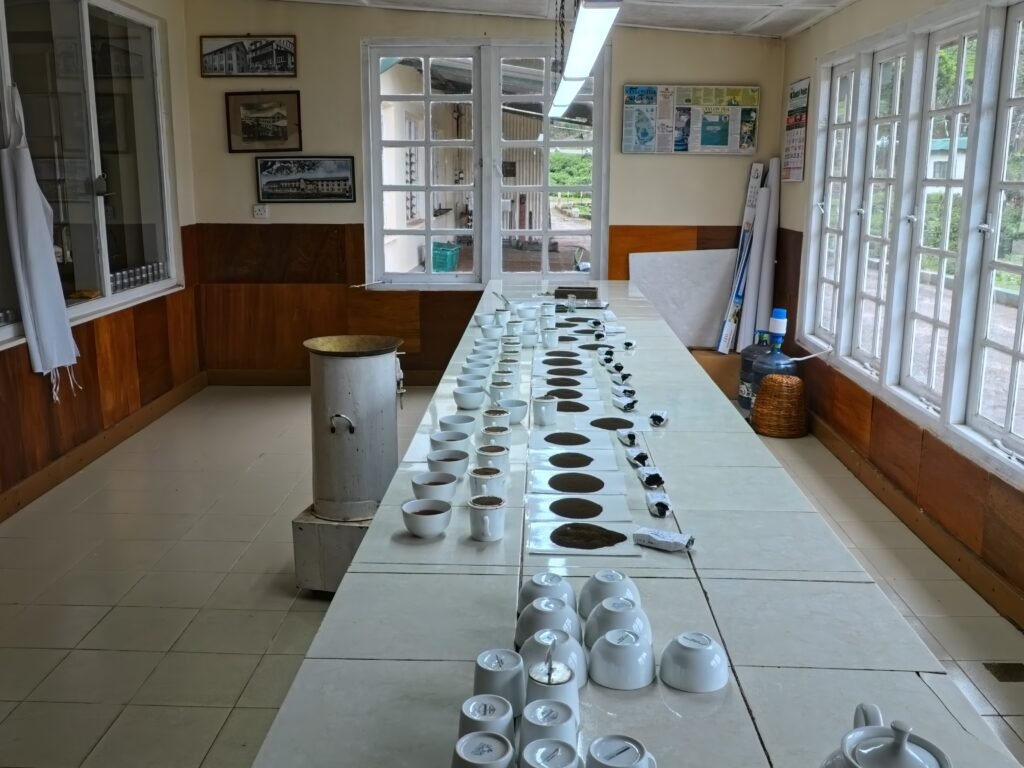
At the end came the tasting. Another man guided us through several different teas. His teeth were stained from constant tea tasting.
Back on the road, we continued towards Horton Plains. Some time later, we stopped at a small roadside café.
The owners’ son was studying music. He didn’t play for us, but I asked if I could at least take a photograph of him with his violin.
In the middle of nowhere, a boy with a violin.
Into Horton Plains
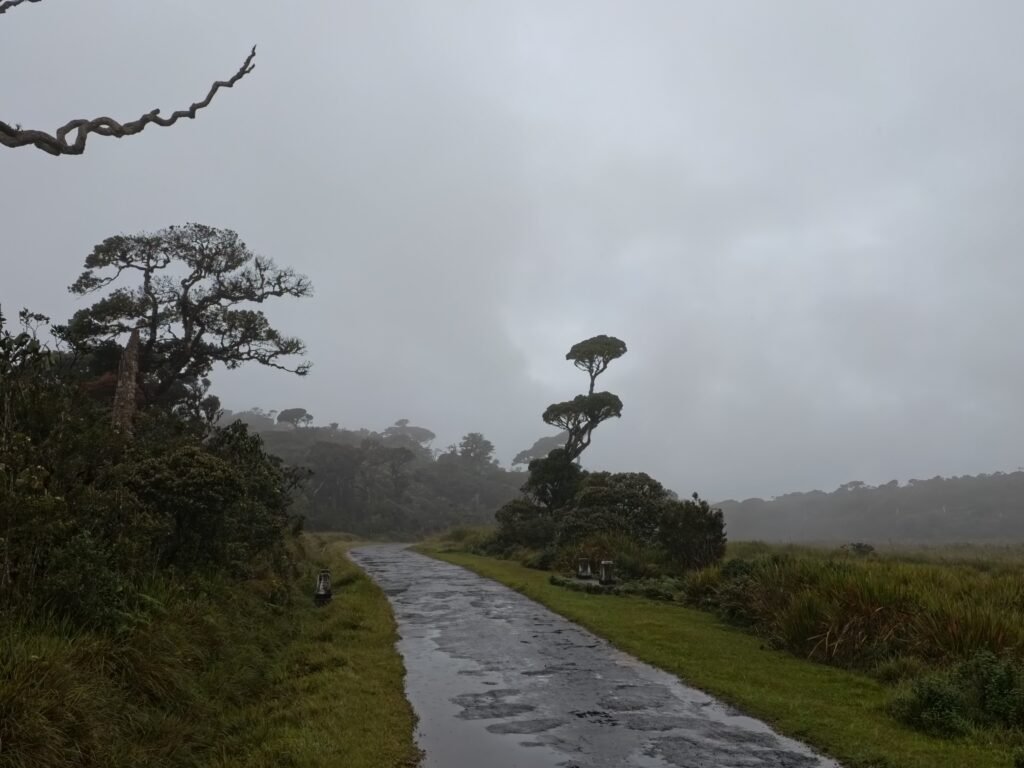
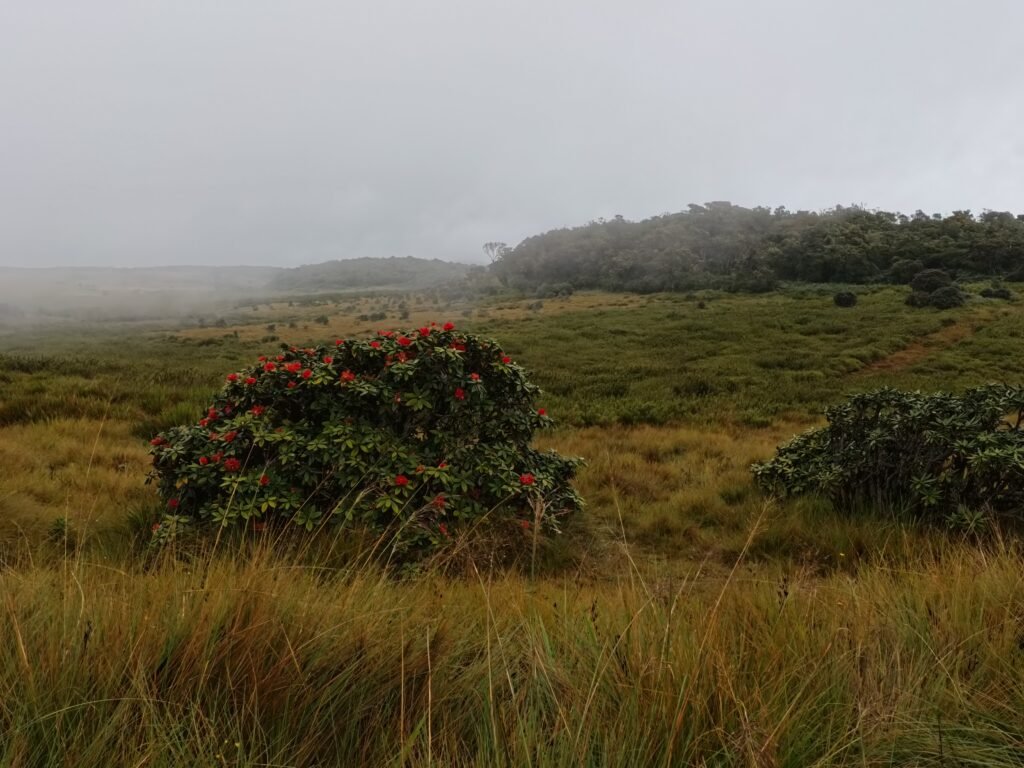
As we climbed higher, the landscape changed again. By the time we reached Horton Plains, the tea-covered slopes were gone. This high plateau in Sri Lanka’s central highlands is a landscape of montane grassland and cloud forest.
That afternoon, much of it seemed to exist inside the clouds. Open plains faded into the mist, while strangely shaped trees emerged and vanished again.
We crossed the park by car. Rain reduced the world around us to the wet track ahead and whatever came into view.
Somewhere along the way, a sambar stood by the roadside.
After a brief stop at the small museum, we continued towards Kandy.
A Night in Kandy
We arrived late at night.
Our host, a friend of Claudia — my travel companion from Tangalle — had turned part of his family home into a homestay. He was a gentle, attentive man and the father of three young children.
His English was excellent. In fact, it was the only language he spoke. Although Sri Lankan by origin, he had grown up abroad and spoke neither Sinhala nor Tamil.
It made me think about how often English had become a common language among Sri Lankans themselves during my journey. Sinhala and Tamil are different languages, and not everyone speaks both. With Anusha, for example, we communicated in English because she spoke Tamil.
The next morning, we went into Kandy. We were looking for somewhere quiet to have breakfast before seeing the city and visiting the famous Temple of the Sacred Tooth Relic.
Instead, we ended up in a café right in the centre. We went up to the second floor and sat on the balcony with our cappuccinos. Below us, the street was full of traffic and noise.
After the quiet places we had come from, the contrast was almost overwhelming. Muna and I seemed to notice it at the same moment, and we smiled.
Kandy had been the last capital of the Sinhalese kings before the British took control in 1815. Traces of the colonial past were still visible, while cricket — another British legacy — seemed to be everywhere in Sri Lanka.
The Temple of the Sacred Tooth
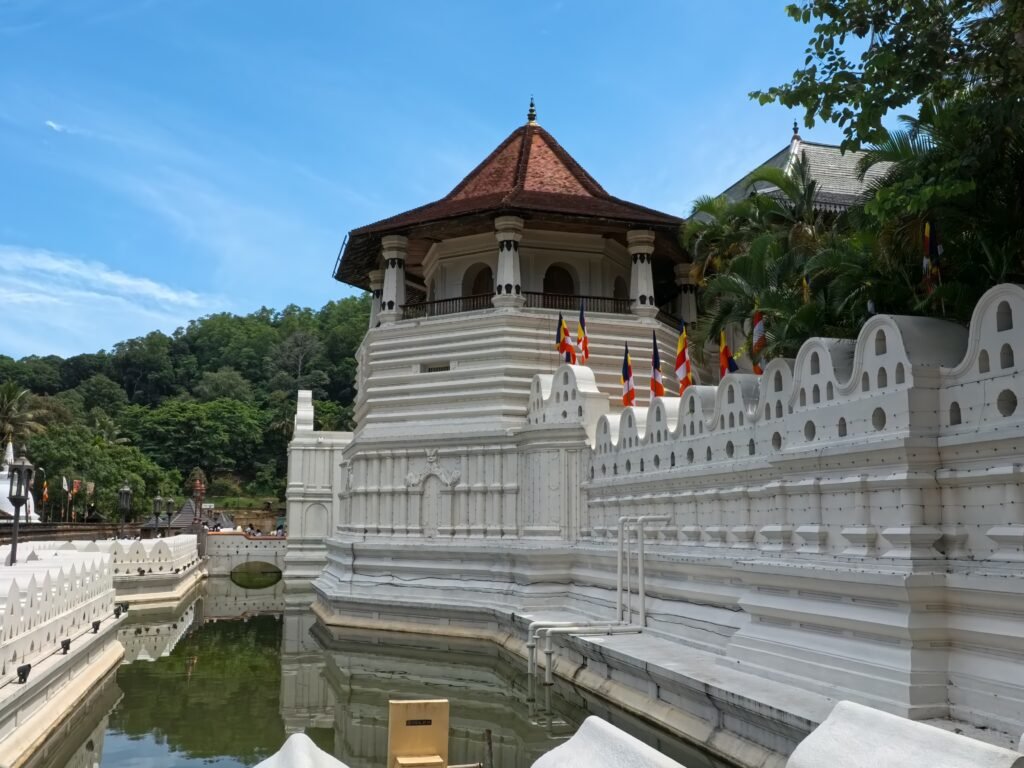
But we had only half a day in Kandy. Our main destination was the Temple of the Sacred Tooth Relic.
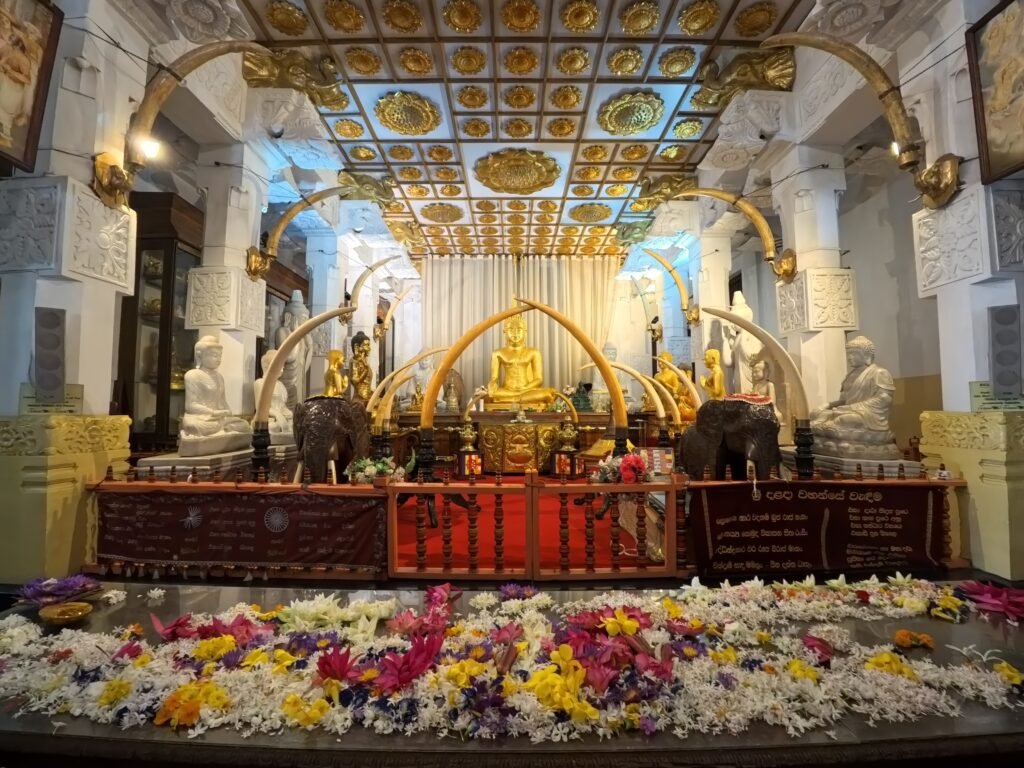
Before entering, we chose lotus flowers to offer at the temple. Then came the queue. It was long, and once inside, the crowd became so dense that we were moving almost shoulder to shoulder.
Yet what I remember most was the devotion. Flowers were carried towards the shrine, people waited patiently, and the sacred area was filled with worshippers.
After visiting the Temple, we spent some time in the museum and wandered through the surrounding grounds.
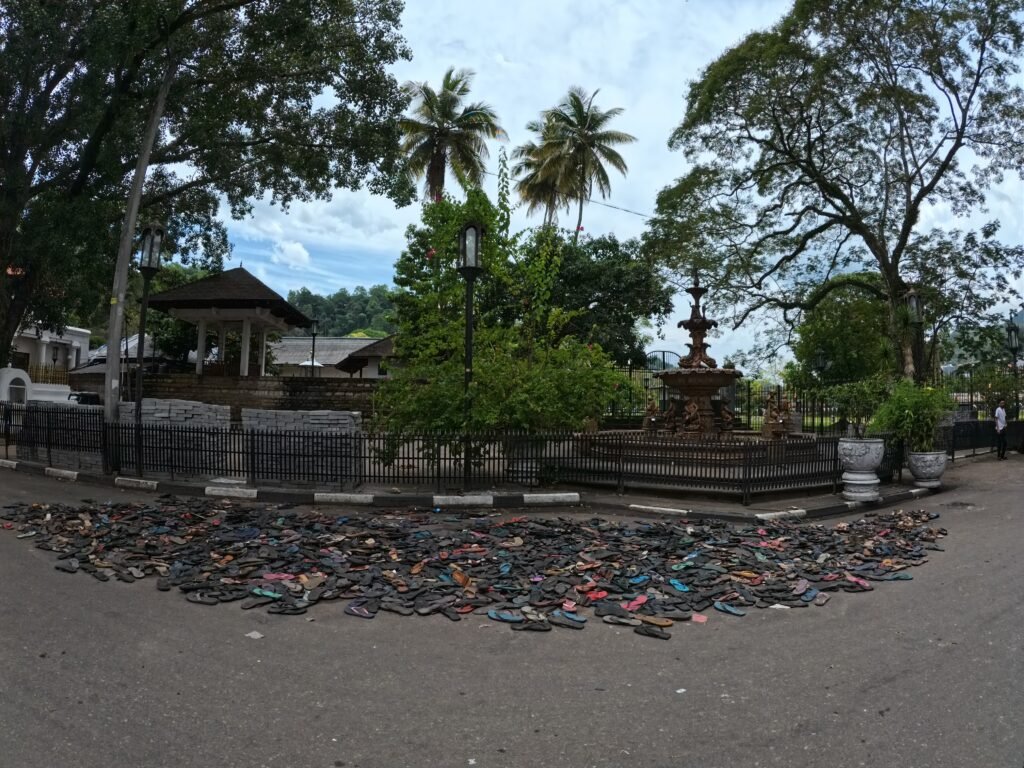
Outside, one image stayed with me: an enormous pile of rubber flip-flops left behind after the festivities.
Before leaving the area, we stopped at a small shop. Muna chose a small statue of Skanda for me.
Only a few days earlier, at Okanda Devalaya, I had encountered Skanda — Murugan — for the first time. Now, in Kandy, he was coming with me.